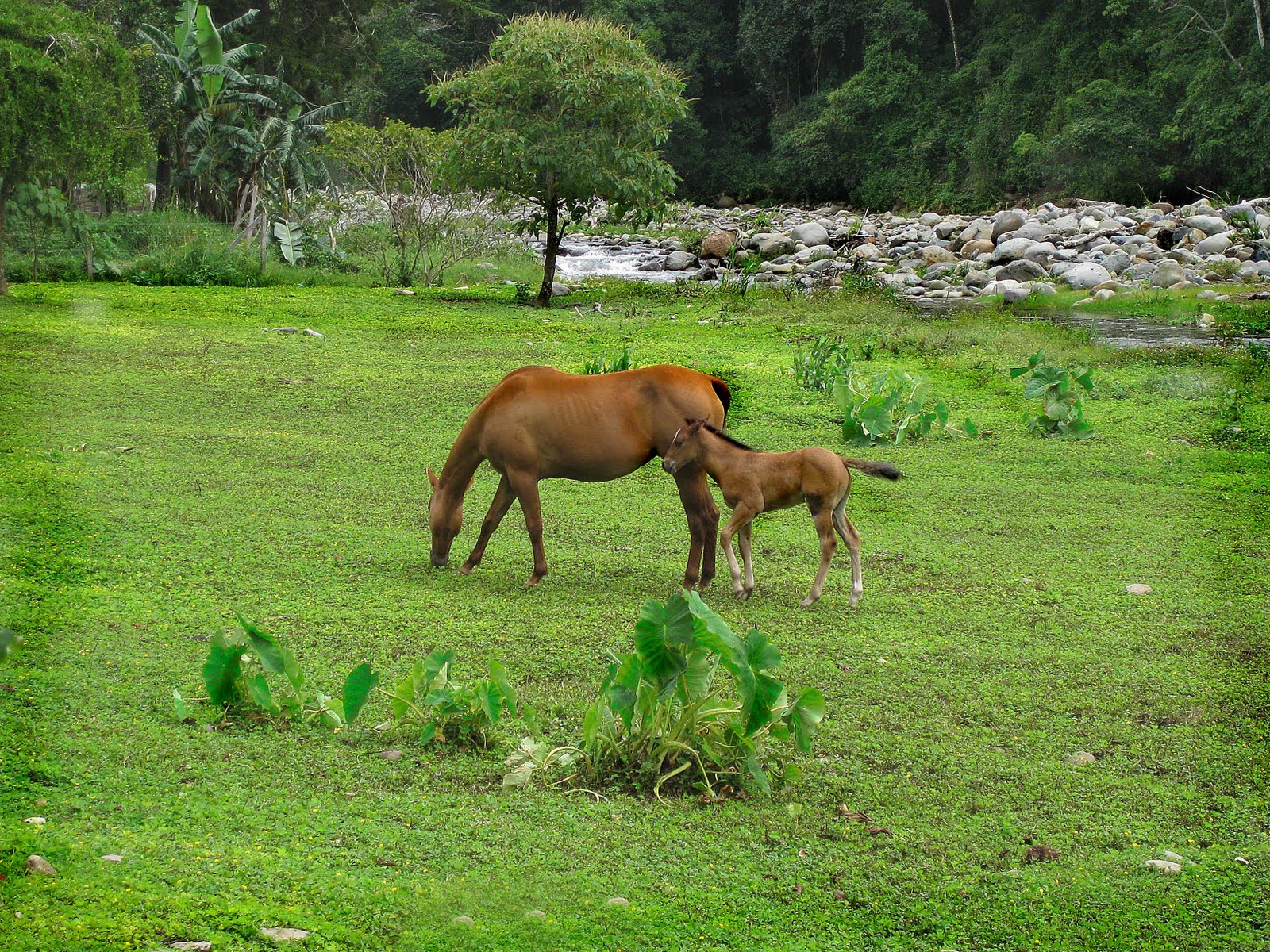
 The small town of Boquete is one of Panama’s most precious scenic gems situated in the highlands with the picturesque Rio Caldera flowing along side the town. The attraction of this simple no frills town nestled in a valley are the countless rolling green hills a paradise for nature lovers, hikers, and even for those who enjoy walking at a leisurely pace. Walking has been one of my favorite means of exercise and now however I never seem to tire hiking in Boquete’s stunning natural jungle up in the highlands. Among many of my favorite locations to hike are in the Horqueta area, the Bajo Mono the rainforest area, or hiking in the lower hot springs
  area of Caldera. Each of these areas has an inherent beauty, continually capturing my interest making each one significant such as; the early morning aromas of spice and pine permeating the air, or the morning dew resting on top of foliage and on beds of fallen leafs, and listening to the trickling sound of the river in the background. This is nature at it's best and what it is all about while I am hiking on the many, many trails of Boquete.
Some trails have an abundance of diverse wild flowers, while others may show off a variety of orchids, or Bromeliads hanging high up from the trees, Heliconias, Bird of Paradise, and sightings of variety of birds such as the Quetzale. The Quetzale
 is a beautiful bird, which you do not want to miss seeing in March through May. During the month of March is when their breeding season commences - the male, performs the courtship dance, calling out, and loudly singing in order to attract a female. This splendid bird is located in the cloud forest jungle among lush vegetation, in the very moist misty cloud zones such as the Pipeline in Bajo Mono or the Quetzale Trail to name a few. Even in July, the Quetzales have been spotted in the areas mentioned.
My love for walking, ahem let me say exercising began in Chicago; jogging along the trail alongside Lake Michigan in
 my thirties, then in my late forties, I began a power walk routine, and bicycling along Chicago’s lakefront trails after moving and living in walking distance to the lake. In my fifties, I began walking 10,000 steps and eventually found the amount of steps not very challenging so I began to walk longer. During the winter months when it is to, too cold for that activity and so I would go to the health club just to stay fit. However, I have to say after moving to Boquete I am in better shape and feel healthier than ever.
Subsequently after moving to Boquete, someone mentioned a walking group had formed; I joined it and began hiking these beautiful trails. It took a while for my body to acclimate to the altitude – Chicago is flat land and Boquete well it is much higher and undulating.
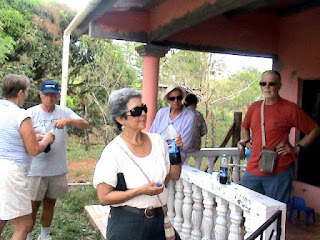
Our group meets every Saturday morning at 8:00am - hiking for about a two-hour more or less. I call our outings hikes because well we are in Boquete with some areas being over 1,400 meters or over 4000 feet above sea level and some of the trails even higher.
 Most of the terrain requires hiking boots for safety since many of the trails are uneven, rocky, with deep gaps, jagged, and loose gravel. For some a walking stick is a big plus it is a balancing tool – I take mine on every hike and love it. The greater part of the trails are on an incline whether hiking up or down hill. Hiking in Boquete may be a challenge for some at first however; your body like mine will acclimate to Boquete’s altitude if you stick with it.
In addition, to Saturday’s walk another two days have been added. Our group on Monday meets at 8am and on Thursday at 8:30am location announced two days prior. Thursday's hike frequently lasting longer about four to five hours sometimes more difficult and for the person who has determination.
Hiking is a great way to exercise, definitely vigorous enough to pump up the heart rate a few notches. Most of the trails are up in the highlands and some are on back dirt roads, where few cars drive. All in all the landscapes, countryside, and views are marvelous – well this is beautiful Boquete
 after all.
I did some research just to find out how many calories a person can burn while hiking on rough terrain like the Peterson #1 Trail, Horqueta #1, Piedra India Trail, to name a few and this is what I found out. Depending on the intensity (your speed, the terrain, the angle of incline, etc.)a person can burn anywhere from 1000 to 1600 calories in total.
When you are exercising, the number of calories you burn depends upon your weight, the activity you are doing and the intensity level you exercise. Active people become slim and stay slim, because they know that burning calories
 allows them to eat a balanced normal diet, while enjoying physical activity.
A person with a higher fitness level will probably exercise at a faster rate and therefore burn more calories than someone who does not work as hard. Whatever exercise activity you choose, you should aim to do it for at least 30 minutes and it should leave you slightly breathless at completion. Above all, you should enjoy the exercise so that you will keep repeating it every day.
The hiking trails below may prove to be difficult at first if you do not walk very much or are sedentary. Here are my suggestions to get your body acclimatized; start by walking around town and take short walks that are on a slight incline. Begin your walking routine for a ½-hour the first 4 days then add 15-minute each week until you can walk for an hour. Do 15-minute stretches prior to walking and stretch afterward. Always take water, wear sunscreen,
 a hat, or cap.
  When hiking in rainforest areas wear long pants, be prepared, your boots may get muddy and wet. In addition every so often we walk across narrow footbridges that are not steady, balance on rocks to cross-streams or rivers, climb over hefty fallen trees or around boulders. It is a wonderful way to exercise and get back into shape.
I decided to write about Boquete’s off the beaten path “hiking trails” to share them with my audience who may be visiting Boquete and to inform you there are many trails to explore in this wonderful area of Panama. If you want to join us one-day contact me, my email address is on my blog. We are a group of Boquete residents who live here permanently and some who do not, the novice or experienced are welcome to join us.
Below is a list of the trails with a brief description of each.
1. River walk loop, 1 ½ to 2 hour – easy for the active person, a challenge for the inactive. A great hike close to town with good views.
 2. Jaramillo Centro loop, 1 ½ to 2 hour. Same as number one but steeper in the beginning then a slight incline going back to town.
3. Cemetery to Volcancito Road, 1 ½ hours for the experienced always on an incline going up, is a challenge for the beginner.
4. Il Pianista, short hike to Señor Ifrain’s property 1 to 2 hours. Trail is a slight incline all the way; balancing on stones and walking across a log is required while crossing a shallow river. Has beautiful landscape and scenery.
5. Cerro Pianista hike into the rain forest from Senor Ifrain’s place 3-4 hours. This is more for
 the experienced.
6. Volcancito - CEFATI loop, 1 ½-2 hours. Road hike on asphalt in the beginning then on a dirt road, then walk down steep stairs going down to main highway.
7. Alto Jaramillo, hike is up and down on dirt road, gravel road 3 to 4 hours. This area has great views of ocean inlets and Boquete and is challenge for the beginner.
8. Piedra India Rock past Alto Jaramillo, 4-hour hike. Begin hiking downhill to Piedra India then a slight incline thereafter the entire way. It is a long hike, never made it to Piedra India rock.
9. Peterson- #1 Trail is along a river going up to Cerro Buenos Aires 3-4 hours. Great hike on a steady upward incline rough terrain. Definitely, for people who are fit and enjoy mountain climbing. There are many birds, great views, narrow rough terrain.
10. Peterson-#2 Trail is a dirt road passing cattle meadows 3 hours. Easier than number nine but still on an incline with rough terrain in some areas.
 11. Bajo Mono Trail AKA Pipeline this is before the Quetzales Trail 3 hours. Steady incline but easy, trail is narrow, wonderful old growth, may hear Howler Monkeys early morning or mid afternoon and we have seen Quetzales in March. At the end of this trail is a beautiful waterfall but you must walk across some rocks to find it.
12. Quetzales Trail 4 hours but did not hike to Cerro Punta. Many birds, beautiful trees, a sheep farm, and the best trout farm along the way. This trail leads to Cerro Punta. Trail is not mark so take your chance when hiking to Cerro Punta. Easy to maneuver.
13. Horqueta Trail 1, 4-5 hours Steep dirt road hike down into this valley then the trail changes upward to a steady incline. You may see and hear Howler Monkeys early, many birds, and orchids. Trail is along coffee fincas. Met the owner of one and he led us further up into hills. Great hike!
14. Horqueta Trail Loop 2.5 hours. Steadily down hill, loose rock, uneven trail until the main asphalt road then
 hike up to the dirt road to the top again. Take another dirt road to lengthen the hike.
15. La Estancia Loop number one 3 hours. Begin at la Estancia hike down onto dirt road and up onto asphalt road looping back to La Estancia.
16. La Estancia to Palmira Centro 4 hours. Begin at La Estancia walk down dirt road continues on dirt road to Palmira Centro hike back.
17. Las Brisas Boqueteneas Canyon 2 hours. Hiking down the canyon is rough terrain with loose rocks so walking stick is helpful. Then hike along the river, somewhat easy, go
 swimming. This hike trail can take you to Potrerillos.
18. Potrerillos from Las Brisas canyon 4.5 hours. Hike from Las Brisas to Potrerillos and back along dirt roads very seldom used.
19. Caldera hike begins along river to new Hot Springs “Mi Abuela” 4.5 hours. Hike on a dirt road it is an easy hike but is very lengthy and hot in the summer. At the end of hike, soak your body in the Caldera Hot Springs or go for a swim in the river.
20. Palo Alto Road to Canopy Tree and beyond into rainforest area 4.5 hours hike. Begin at the “Springs” walk on road which is at a slight incline all the way. Once you reach Canopy Tree walk across river on a footbridge. This is a wonderful rainforest hike; narrow trail on a steady upward incline, soggy, and slippery in areas walking is helpful.
21. Horse Trail in the Santa Lucia area - beautiful trail with many pine trees. Few cars travel on this road it is a 2.5 hours hike.

I am looking at this list of trails and thinking WOW! Not realizing until this writing the many trails we have hiked since we began. It certainly has been, without a doubt a most fantastic, terrific, exhilarating experience, and activity exploring new hiking trails and being able to share them with you. During the rainy season alternate routes may be hiked.
Hope you join us on Saturday, Monday, or Thursday.
See you on the happy trails of Boquete!
All the photos on my blog were taken by me while hiking on some of the beautiful trails mentioned above. See more on my flickr site at,
Explore. Dream. Discover.