We wondered how the weather would be in Colón this time of the year especially since it began raining in Boquete rather early this season. All the same, we decided to take a chance and drive to Colón with a few places in mind exploring, Gamboa, Isle Barro Colorado, Sierra Llorena, and Portobelo.
Our first stop was in Santiago to have lunch at the cafeteria next to the Texaco gas station, a favorite spot along the way, and halfway point to PC.
The drive to Gamboa was very easy thanks to our navigator Remi who has a first-rate sense of direction. Instead of going through Panama City, we drove across the New Centenary Bridge arriving to our destination quicker and a great deal easier.
The name Gamboa is the name of a tree from the quince family. We would be spending two days in Gamboa though not at the Gamboa Resort but at one of the few B and B’s located in the formerly known American Canal Zone residential area for workers. Gamboa is located on a sharp bend of the Chagres River at the point, which feeds Lake Gatun. A single lane iron and wood bridge crosses the Chagres River and is the only road access to Gamboa. Vehicles waiting to pass over the bridge must wait at the stoplight to cross the bridge, since it is only capable of providing space for one lane of traffic at a time. Here are fact-finding details about the bridge: The single lane/wood tracking – traffic controlled bridge, is a 100 years-old, and designed by Ferdinand de Lesseps, a French man in charge of the French portion of the Panama Canal construction. Born on November 19, 1805 in Versailles, at the age 19, he studied law, and then appointed by his to his uncle, then the French ambassador to Lisbon. In 1875, de Lesseps made his first public declaration of interest in an inter-oceanic canal. By the end of January 1881, the great task of construction commenced.
 Gamboa
We stayed at Mateo’s B & B the proprietors are Mateo and his wife Beatrice and I understand they have been married for more than 40 years. Mateo is retired from being an employee of the Canal and mentioned they once had a home where the Gamboa Resort is located but relocated to where he now lives.
Both are very hospitable and have two small separate cabanas and one large apartment above their home the apartment is furnished. Fortunately, for us, even though we had booked the two small cabanas Beatrice asked if we would prefer to stay in the large furnished apartment since it was available and we decided to do so since it would be for the same price of 35.00 dollars per person. Amenities include coffee, a cold breakfast that included cereal, fruit, toast. They have an attractive landscape filled with flowers, with birds such as Chachalacas, hummingbirds, a variety of tanagers, and more. It is a very peaceful setting listening to the birds and the water fountain on their property while enjoying breakfast.
The Mateo B & B offers breakfast only and furthermore Gamboa has few restaurants; however, there are fondas (a small outdoor restaurant) unfortunately they close early. On the other hand, the Gamboa Resort serves dinner until eight in the evening and has an extensive menu and good. I should add Mateo is willing to show you around the island, will answer your questions providing information about the area.
 Barro Colorado Isla
We made prior arrangements to tour the Barro Colorado Isla (BCI) where the Smithsonian Tropical Research Institute has a permanent research center, and dedicated to studying rainforest ecosystems. Barro Colorado Isa (BCI) is located in the fabricated Gatun Lake in the middle of the Panama Canal and one of the largest man-made lakes in the world. The island formed when the waters of the Chagres River were dammed to form the lake. When the waters rose, they covered a significant part of the existing rainforest, and the hilltops remained as islands in the middle of the lake. It has an area of 15 square kilometers (5.79 sq mi).
 The island is a capsule of biodiversity that provides an opportunity for scientists to monitor population changes and test diversity theories about the rainforests without having their studies encroached upon by outsiders. Each year between two hundred and four hundred international scientists visit Barro Colorado, making this one of the well studied forests in the world. Scientists have so far discovered 1200 plants, 120 mammals, and innumerable insects on the island. At the same time though when visiting the island you will notice very little wildlife.
In order to visit the Isla Barro Colorado prior arrangements is necessary, the fee is 25.00 dollars per person for the tour, includes a guide and buffet lunch. This is a day trip with the boat leaving Gamboa at 7:15am sharp returning around 3pm. Important: this purchase is not refundable or transferable. All cancellations need to be made at least fifteen days before the reserved date. In this case, you will receive a refund of your payment minus 20% to cover administrative costs. “No shows” will not receive reimbursements. Check their website for further information.
http://www.stri.org/english/visit_us/barro_colorado/
It is a fascinating tour where names of trees are pointed out, as to the extent research is performed, or information about different projects such as focusing on the monitoring of climatic conditions in relation to the populations of particular plants and animals.
Here are few other facts we learned from our guide.
The Barro Colorado Nature Monument includes Barro Colorado Island and the five surrounding mainland peninsulas: Gigante, Peña Blanca, Bohío, Buena Vista, and Frijoles.
The area of the Island is 1,500 hectares, whereas the area of the entire Monument is 5,600 hectares.
The annual precipitation on the Island is 2,600mm of rain. Leaf cutter ants cut more than 15% of all the leaves produced in the forest to fertilize the fungus that they eat in subterranean nests. Fig wasps may travel up to 9 miles to pollinate fig fruit.
The majority of fruit in the forest produces in July and in September. In El Niño years, more fruit produces.
A big Espavé tree (Anacardium excelsum) pumps 54kg of water from the soil up into leaves, every day.
Five monkey species live on Barro Colorado, all native to Panama: Spider Monkey, White-Faced Capuchin, Geoffrey's Tamarin, Howler Monkey, and Night Monkey.
Our first stop was in Santiago to have lunch at the cafeteria next to the Texaco gas station, a favorite spot along the way, and halfway point to PC.

The drive to Gamboa was very easy thanks to our navigator Remi who has a first-rate sense of direction. Instead of going through Panama City, we drove across the New Centenary Bridge arriving to our destination quicker and a great deal easier.

The name Gamboa is the name of a tree from the quince family. We would be spending two days in Gamboa though not at the Gamboa Resort but at one of the few B and B’s located in the formerly known American Canal Zone residential area for workers. Gamboa is located on a sharp bend of the Chagres River at the point, which feeds Lake Gatun. A single lane iron and wood bridge crosses the Chagres River and is the only road access to Gamboa. Vehicles waiting to pass over the bridge must wait at the stoplight to cross the bridge, since it is only capable of providing space for one lane of traffic at a time. Here are fact-finding details about the bridge: The single lane/wood tracking – traffic controlled bridge, is a 100 years-old, and designed by Ferdinand de Lesseps, a French man in charge of the French portion of the Panama Canal construction. Born on November 19, 1805 in Versailles, at the age 19, he studied law, and then appointed by his to his uncle, then the French ambassador to Lisbon. In 1875, de Lesseps made his first public declaration of interest in an inter-oceanic canal. By the end of January 1881, the great task of construction commenced.
 Gamboa
We stayed at Mateo’s B & B the proprietors are Mateo and his wife Beatrice and I understand they have been married for more than 40 years. Mateo is retired from being an employee of the Canal and mentioned they once had a home where the Gamboa Resort is located but relocated to where he now lives.
Both are very hospitable and have two small separate cabanas and one large apartment above their home the apartment is furnished. Fortunately, for us, even though we had booked the two small cabanas Beatrice asked if we would prefer to stay in the large furnished apartment
 since it was available and we decided to do so since it would be for the same price of 35.00 dollars per person. Amenities include coffee, a cold breakfast that included cereal, fruit, toast. They have an attractive landscape filled with flowers, with birds such as Chachalacas, hummingbirds, a variety of tanagers, and more. It is a very peaceful setting listening to the birds and the water fountain on their property while enjoying breakfast.
The Mateo B & B offers breakfast only and furthermore Gamboa has few restaurants; however, there are fondas (a small outdoor restaurant) unfortunately they close early. On the other hand, the Gamboa Resort serves dinner until eight in the evening and has an extensive menu and good. I should add Mateo is willing to show you around the island, will answer your questions providing information about the area.
 Barro Colorado Isla
We made prior arrangements to tour the Barro Colorado Isla (BCI) where the Smithsonian Tropical Research Institute has a permanent research center, and dedicated to studying rainforest ecosystems. Barro Colorado Isa (BCI) is
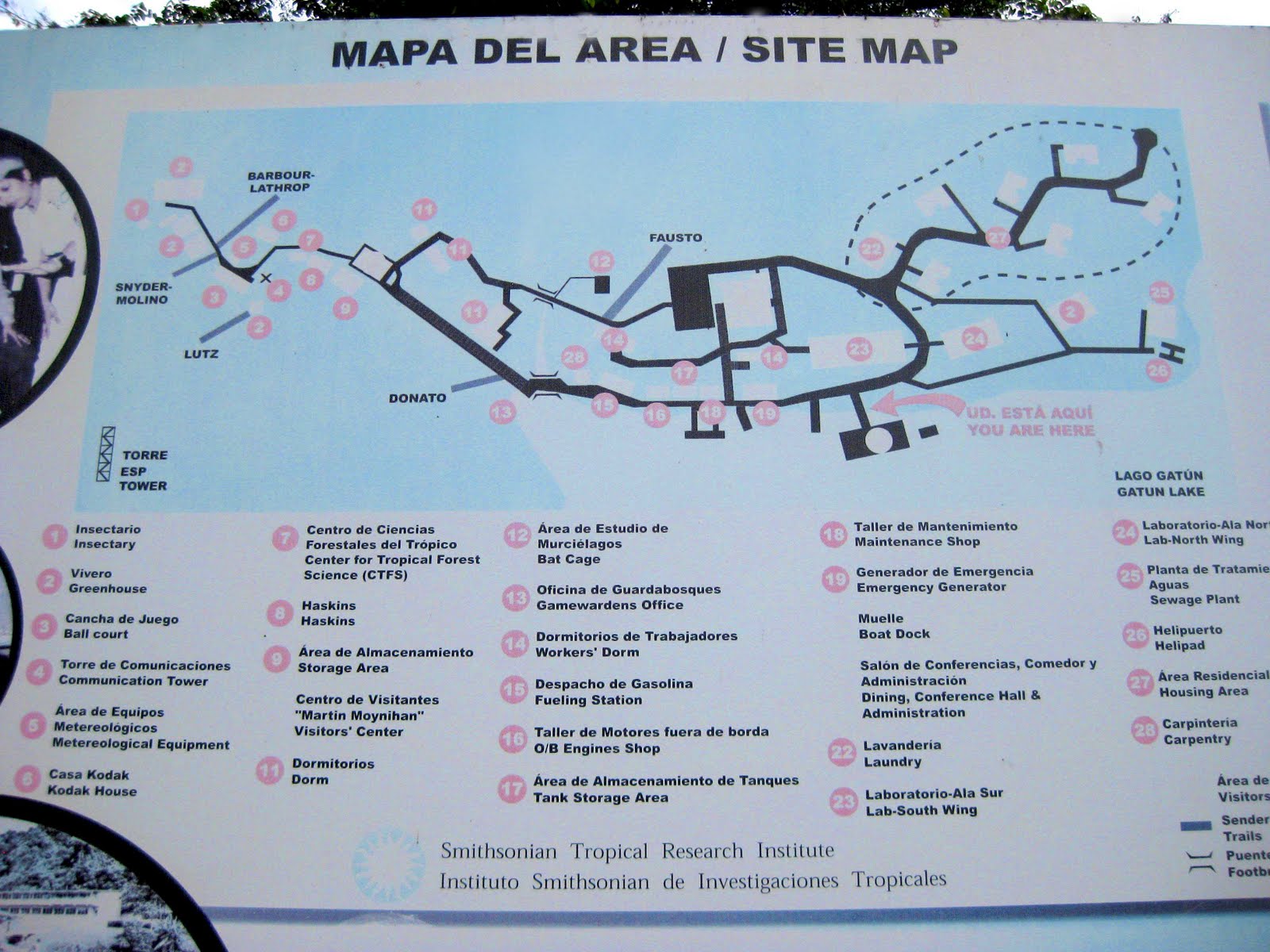 located in the fabricated Gatun Lake in the middle of the Panama Canal and one of the largest man-made lakes in the world. The island formed when the waters of the Chagres River were dammed to form the lake. When the waters rose, they covered a significant part of the existing rainforest, and the hilltops remained as islands in the middle of the lake. It has an area of 15 square kilometers (5.79 sq mi).
 The island is a capsule of biodiversity that provides an opportunity for scientists to monitor population changes and test diversity theories about the rainforests without having their studies encroached upon by outsiders. Each year between two hundred and four hundred international scientists visit Barro Colorado, making this one of the well studied forests in the world. Scientists have so far discovered 1200 plants, 120 mammals, and innumerable insects on the island. At the same time though when visiting the island you will notice very little wildlife.
In order to visit the Isla
 Barro Colorado prior arrangements is necessary, the fee is 25.00 dollars per person for the tour, includes a guide and buffet lunch. This is a day trip with the boat leaving Gamboa at 7:15am sharp returning around 3pm. Important: this purchase is not refundable or transferable. All cancellations need to be made at least fifteen days before the reserved date. In this case, you will receive a refund of your payment minus 20% to cover administrative costs. “No shows” will not receive reimbursements. Check their website for further information.
http://www.stri.org/english/visit_us/barro_colorado/
It is a fascinating tour where names of trees are pointed out, as to the extent research is performed, or information about different projects such as focusing on the monitoring of climatic conditions in relation to the populations of particular plants and animals.
Here are few other facts we learned from our guide.
The Barro Colorado Nature Monument includes Barro Colorado Island and the five surrounding mainland peninsulas: Gigante, Peña Blanca, Bohío,
 Buena Vista, and Frijoles.
The area of the Island is 1,500 hectares, whereas the area of the entire Monument is 5,600 hectares.
The annual precipitation on the Island is 2,600mm of rain. Leaf cutter ants cut more than 15% of all the leaves produced in the forest to fertilize the fungus that they eat in subterranean nests. Fig wasps may travel up to 9 miles to pollinate fig fruit.
The majority of fruit in the forest produces in July and in September. In El Niño years, more fruit produces.
A big Espavé tree (Anacardium excelsum) pumps 54kg of water from the soil up into leaves, every day.
Five monkey species live on Barro Colorado, all native to Panama: Spider Monkey, White-Faced Capuchin, Geoffrey's Tamarin, Howler Monkey, and Night Monkey.
Visiting a Wounaan Village in Gamboa
On our third day, Mateo connected us with a guide named Armodio to visit a Wounaan Village on Isla San Antonio in the Gamboa area. Isla San Antonio is a small island located at the Pacific end of Lake Gatun. There are now probably less than 3,000 Wounaan indigenous people living in the virgin rainforests of Panama, many mainly living in the province of Darien. Our guide charged 15.00 dollars per person for a two-hour tour of their village taking us for a boat ride to Isla San Antonio. The first stage of the journey is through a dense carpet of water plants such as lilies and we saw a variety of water birds along the way. You then come onto a lake surface so still and shiny, it is like a mirror and I understand there are Cayman (small alligators) that live in the water.
During our visit, Armodio tells us about the Wounaan culture, mentioning the men dress in their traditional loincloth in the village but elsewhere wear typical long pants and shirt. We follow Armodio for a short walk in the forest; he explains how his people uses various trees and plants for construction, food, medicine, and magic charm.
However, there is some tension between the Wounaan way of life and the modern Panamanian government, for Isla San Antonio is now part of a national park. Consequently, certain activities, such as felling trees, are against the law. A tree needs to fall down naturally before they can make a new cayuco.
After our walk, some of the women in the village performed traditional dances one called “Hombre Guerrero”, another “Danza de Bultre.” The villagers also set up a bench of art and basketwork when they have visitors, with sculpted tagua or ivory nut (the seed of a palm that grows in the tropical rainforest), and sculptures made out of the rich red-brown wood of the cocobolo tree. The art of the Wounaan based principally on woodcarving and basket weaving, all of the materials, including pigments, coming from the forest around them. Wounaan’s intricate handicrafts are in demand worldwide. Some believe they were the original basket weavers and wood carvers in the region. You can help them by buying pieces of art; all the pieces reasonably priced.
Their goal is to build a few cabanas on their island in order to attract the visitor who is interested in exploring the Wounaan’s lifestyle and culture. I found this group of Wounaan open and not shy, willing to have photographs taken of them and friendly.
On our third day, Mateo connected us with a guide named Armodio to visit a Wounaan Village on Isla San Antonio in the Gamboa area. Isla San Antonio is a small island located at the Pacific end of Lake Gatun. There are now probably less than 3,000 Wounaan indigenous people living in the virgin rainforests of Panama, many mainly living in the province of Darien. Our guide charged 15.00 dollars per person for a two-hour tour of their village taking us for a boat ride to Isla San Antonio. The first stage of the journey is through a dense carpet of water plants such as lilies and we saw a variety of water birds along the way. You then come onto a lake surface so still and shiny, it is like a mirror and I understand there are Cayman (small alligators) that live in the water.

During our visit, Armodio tells us about the Wounaan culture, mentioning the men dress in their traditional loincloth in the village but elsewhere wear typical long pants and shirt. We follow Armodio for a short walk in the forest; he explains how his people uses various trees and plants for construction, food, medicine, and magic charm.
However, there is some tension between the Wounaan way of life and the modern Panamanian government, for Isla San Antonio is now part of a national park. Consequently, certain activities, such as felling trees, are against the law. A tree needs to fall down naturally before they can make a new cayuco.
After our walk, some of the women in the village performed traditional dances one called “Hombre Guerrero”, another “Danza de Bultre.” The villagers also set up a bench of art and basketwork when they have visitors, with sculpted tagua or ivory nut (the seed of a palm that grows in the tropical rainforest), and sculptures made out of the rich red-brown wood of the cocobolo tree. The art of the Wounaan based principally on woodcarving and basket weaving, all of the materials, including pigments, coming from the forest around them. Wounaan’s intricate handicrafts are in demand worldwide. Some believe they were the original basket weavers and
 wood carvers in the region. You can help them by buying pieces of art; all the pieces reasonably priced.
Their goal is to build a few cabanas on their island in order to attract the visitor who is interested in exploring the Wounaan’s lifestyle and culture. I found this group of Wounaan open and not shy, willing to have photographs taken of them and friendly.

Here are a few facts about the Wounaan of San Antonio. The Wounaan are one of seven indigenous groups in Panama. For centuries, the Wounaan lived as semi-nomadic forest dwellers that hunted and fished. Today, they still live a traditional lifestyle in the Panamanian rainforest, and their culture centers around family, nature, and artisanship; however, the Wounaan are not strangers to modern culture.


A well-known Wounaan, Manuel Antonio Zarco, taught U.S. astronauts Neil Armstrong, John Glenn, and Gordon Cooper survival skills in the jungles of Panama in the 1950s.
In 1958, Zarco settled his family on the shores of Lake Gatún and established an Emberá-Wounaan community, and his descendents live in the village of San Antonio today.For centuries, they traveled the river in a narrow dugout canoe called a piragua, carved out of a single large tree trunk. Today, the Wounaan remain master navigators and take visitors on piragua excursions on the Chagres River.
Summit Parque Nacional
On the same day before leaving Gamboa, we visited Summit Parque Muncipal and Zoo, the entrance fee is one dollar, and hours are from 9am to 4pm. The park known, as the Summit Gardens is a forest reserve turned park it houses many interesting tagged trees with their name.


The park has an area specifically for plants and orchids, but the park’s 700-acre area is mostly destined for animal exhibits and recreation facilities for the whole family. Since the size of Summit is considerable, visitors are handed a thorough map of the premises upon entering the park. Reaching the park is also relatively easy: located at the entrance of Gamboa, the sign is hard to miss.
Sierra Llorona Lodge a Hiker's and Birders Paradise
We proceed after the Parque Nacional Summit to Sierra Llorona Lodge which means “Crying Mountain” a converted home nestled in a gorgeous jungle setting of 200 hectares (499 acres) of private rainforest, home to 150 bird species, ideal for traveling bird-watchers and hikers. All the
  same, Sierra Llorona would appeal to any traveler looking for a peaceful place to commune with nature. The lodge is family-run, with very friendly, personalized service, and with group meals. Guest rooms, like the lodge as a whole, are simply furnished but attractive and neat as a pin. Rooms do not have A/C but do have a ceiling fan in the rooms needed because the humidity level is especially HIGH.
Robert Caballero manager of the lodge greeted us asking if we would prefer to have him speak either English or Spanish, naturally we say Spanish or both. He is very helpful, his English very good, and eager to make your stay at Sierra Llorona a memorable one.
We stayed only two nights here and would have stayed longer but since I had made other plans in Boquete prior to this trip, we were unable to.


Sierra Llorona Lodge a Hiker's and Birders Paradise
We proceed after the Parque Nacional Summit to Sierra Llorona Lodge which means “Crying Mountain” a converted home nestled in a gorgeous jungle setting of 200 hectares (499 acres) of private rainforest, home to 150 bird species, ideal for traveling bird-watchers and hikers.
 All the
  same, Sierra Llorona would appeal to any traveler looking for a peaceful place to commune with nature. The lodge is family-run, with very friendly, personalized service, and with group meals. Guest rooms, like the lodge as a whole, are simply furnished but attractive and neat as a pin. Rooms do not have A/C but do have a ceiling fan in the rooms needed because the humidity level is especially HIGH.
Robert Caballero manager of the lodge greeted us asking if we would prefer to have him speak either English or Spanish, naturally we say Spanish or both. He is very helpful, his English very good, and eager to make your stay at Sierra Llorona a memorable one.
We stayed only two nights here and would have stayed longer but since I had made other plans in Boquete prior to this trip, we were unable to.


The lodge has a guide and management suggests a guide for first time guests. On our visit, Jorge was our guide and I highly recommend him for any of the four hiking trails that Sierra Llorona offers. He is not only a guide but also a scout always looking for something interesting to show his visitors and I understand why Jorge was a park ranger in the Darien. Having a guide on your hike comes with the package and available at any time just let Robert know ahead of time to schedule him in during your stay. Sierra Llorena is such a peaceful, picturesque, gorgeously lush place to visit we will definitely go back. I have included a bird list from the lodge’s website.
http://www.sierrallorona.com/bird-list.php
Historic Portobelo
Our day trip to Portobelo proved to be fascinating and very informative for us. If you are a history buff, you will enjoy touring the ruins and the Real Aduana de Portobelo (Customs House) in Portobelo.
 Originally named “Puerto Bello” by Christopher Columbus on his first visit here in 1502, over the centuries the name gradually changed to Portobelo. It is a modest seaside port village in the Colón Province built among the ruins of what was one of Spain’s richest and liveliest ports from the mid-16th to early 18th century. Portobelo founded in 1597 by Spanish explorer Francisco Velarde y Mercado. From the sixteenth to the eighteenth centuries, it was an important silver-exporting port in New Granada on the Spanish Main and one of the ports on the route of the Spanish treasure fleets. The city was also the victim of one of Captain Henry Morgan's notorious adventures. In 1668, Morgan led a fleet of privateers and 450 men against Portobelo, which, in spite of its good fortifications, he captured and plundered for 14 days, stripping it of nearly all its wealth.
Today the two forts of Portobelo, Batería Santiago a defensive fort built after the famous raid on Portobelo by the British Admiral Edward Vernon in 1739 and Casa Fuerte Santiago, which overlooked the bay and acted as a depository for ammunition built.
 The Real Aduana de Portobelo located in front of the parque (plaza) in the center of town is a highlight in Portobelo. This old good-looking building still stands today now restored it houses a small museum with a $1.00 entrance fee. The Customs house was the “counting house” during the Spanish colonial days, so named for the gold and silver counted, registered, and distributed here. Built by the Spanish in 1630, it was than damaged in both 1744, by a canon and in 1882 by an earthquake. Even though many of the ruins still stand today from battles many centuries ago, today unfortunately they are littered with graffiti; though the ancient rusty canons are in place, as are the moats, and a sentry box. For history buffs, I found several links with more about Portobelo. http://bruceruiz.net/PanamaHistory/porto_bello.htm and http://www.bjmjr.net/afromestizo/panama.htm
 Facts about the “Congo” community of Portobelo
For many sea weary Africans, Portobelo was simultaneously the end of the horrid Middle Passage and the beginning of slavery in a foreign land. The Congos of Portobelo are descendants of the cimarrones or marronage meaning "runaway slave" in Spanish. They fiercely fought for their freedom during the Spanish colonial period the African forced to Panama as slaves during Spanish colonization. After escaping into the hills and the rain forests, the Cimarrones built fortified villages known as palenques from which they waged war against their former enslavers. So successful in war the Spaniards were forced to declare several truces, and finally recognize their freedom. I came across this blog site finding it to points of interest regarding the Congo population in Colon and the Black Panamanian. http://blogs.wofford.edu/presidential_scholar/2009/10/congo-dance-of-panama.html
 On the website below the article is dedicated to Claral Richards who I had the pleasure of meeting at a celebration given in his honor in Puerto Armuelles where he was born and raised from Puerto Armuelles just the other day a fascinating man. The website has additional history of the Black Panamanian. http://www.cwo.com/~lucumi/panama.html
Portobelo - Black Christ
One other point of interest for visiting Portobelo is the priceless relic and carefully guarded beautifully carved statue of Jesus of Nazareth, which, because it is made of dark wood, is known as the “Black Christ.” Every year on 21st of October, Portobelo relives a day of its glorious past in a celebration in honor of the lack Christ. The city fills with people in a candlelight procession. The statue of the Black Christ is brought out of the church on a platform transported by 80 men and is carried through the streets of the city. Hundreds of pilgrims carrying candles march behind the statue until once again restored to its resting place returning the Black Christ to Iglesia de San Felipe.
Oral history in Portobelo also tells of a crate containing a black sculptural figure of Jesus Christ "magically" appearing in the bay during a cholera epidemic. It was brought ashore by two fishermen. Shortly after, the people of the village began praying before the figure and the epidemic miraculously ended. As a result, each year for the last three centuries, as many as 60,000 devotees who have made pilgrimages to visit the figure on 21 of October have celebrated the Feast Day of the Cristo Negro de Portobelo - Black Christ of Portobelo.
 There are many reasons why I decided to retire and live in Panama; one is due to the country’s deep long-standing culture, and history it possesses. While living in Panama take advantage and take a trip back in time learning about its history such as the locations you have just read. Even though it has been a small struggling country, it still stands tall, and continues to breathe life, boasting a rich history, a diverse selection of landscapes with thick lowland jungle and white-sand beaches, a melting pot of cultures, and experiences. I for one have a good deal to learn about this beautiful country and will continue to Explore, Dream, and Discover I hope you will as well.
http://www.sierrallorona.com/bird-list.php
Historic Portobelo
Our day trip to Portobelo proved to be fascinating and very informative for us. If you are a history buff, you will enjoy touring the ruins and the Real Aduana de Portobelo (Customs House) in Portobelo.

 Originally named “Puerto Bello” by Christopher Columbus on his first visit here in 1502, over the centuries the name gradually changed to Portobelo. It is a modest seaside port village in the Colón Province built among the ruins of what was one of Spain’s richest and liveliest ports from the mid-16th to early 18th century. Portobelo founded in 1597 by Spanish explorer Francisco Velarde y Mercado. From the sixteenth to the eighteenth centuries, it was an important silver-exporting port in New Granada on the Spanish Main and one of the ports on the route of the Spanish treasure fleets. The city was also the victim of one of Captain Henry Morgan's notorious adventures. In 1668, Morgan led a fleet of privateers and 450 men against Portobelo, which, in spite of its good fortifications, he captured and plundered for 14 days, stripping it of nearly all its wealth.
Today the two forts of Portobelo, Batería Santiago a defensive fort built after the famous raid on Portobelo by the British Admiral Edward Vernon in 1739 and Casa Fuerte Santiago, which overlooked the bay and acted as a depository for ammunition built.

 The Real Aduana de Portobelo located in front of the parque (plaza) in the center of town is a highlight in Portobelo. This old good-looking building still stands today now restored it houses a small museum with a $1.00 entrance fee. The Customs house was the “counting house” during the Spanish colonial days, so named for the gold and silver counted, registered, and distributed here. Built by the Spanish in 1630, it was than damaged in both 1744, by a canon and in 1882 by an earthquake. Even though many of the ruins still stand today from battles many centuries ago, today unfortunately they are littered with graffiti; though the ancient rusty canons are in place, as are the moats, and a sentry box. For history buffs, I found several links with more about Portobelo. http://bruceruiz.net/PanamaHistory/porto_bello.htm and http://www.bjmjr.net/afromestizo/panama.htm
 Facts about the “Congo” community of Portobelo
For many sea weary Africans, Portobelo was simultaneously the end of the horrid Middle Passage and the beginning of slavery in a foreign land. The Congos of Portobelo are descendants of the cimarrones or marronage meaning "runaway slave" in Spanish. They fiercely fought for their freedom during the Spanish colonial period the African forced to Panama as slaves during Spanish colonization. After escaping into the hills and the rain forests, the Cimarrones built fortified villages known as palenques from which they waged war against their former enslavers. So successful in war the Spaniards were forced to declare several truces, and finally recognize their freedom. I came across this blog site finding it to points of interest regarding the Congo population in Colon and the Black Panamanian. http://blogs.wofford.edu/presidential_scholar/2009/10/congo-dance-of-panama.html
 On the website below the article is dedicated to Claral Richards who I had the pleasure of meeting at a celebration given in his honor in Puerto Armuelles where he was born and raised from Puerto Armuelles just the other day a fascinating man. The website has additional history of the Black Panamanian. http://www.cwo.com/~lucumi/panama.html
Portobelo - Black Christ
One other point of interest for visiting Portobelo is the priceless relic and carefully guarded beautifully carved statue of Jesus of Nazareth, which, because it is made of dark wood, is known as the “Black Christ.” Every year on 21st of October, Portobelo relives a day of its glorious past in a celebration in honor of the lack Christ. The city fills with people in a candlelight procession. The statue of the Black Christ is brought out of the church on a platform transported by 80 men and is carried through the streets of the city.
 Hundreds of pilgrims carrying candles march behind the statue until once again restored to its resting place returning the Black Christ to Iglesia de San Felipe.
Oral history in Portobelo also tells of a crate containing a black sculptural figure of Jesus Christ "magically" appearing in the bay during a cholera epidemic. It was brought ashore by two fishermen. Shortly after, the people of the village began praying before the figure and the epidemic miraculously ended. As a result, each year for the last three centuries, as many as 60,000 devotees who have made pilgrimages to visit the figure on 21 of October have celebrated the Feast Day of the Cristo Negro de Portobelo - Black Christ of Portobelo.

 There are many reasons why I decided to retire and live in Panama; one is due to the country’s deep long-standing culture, and history it possesses. While living in Panama take advantage and take a trip back in time learning about its history such as the locations you have just read. Even though it has been a small struggling country, it still stands tall, and continues to breathe life, boasting a rich history, a diverse selection of landscapes with thick lowland jungle and white-sand beaches, a melting pot of cultures, and experiences. I for one have a good deal to learn about this beautiful country and will continue to Explore, Dream, and Discover I hope you will as well.